The Old Seven Mile Bridge has been a railroad, a toll highway, a two-lane road and now a path for walkers and cyclists. This timeline runs from Henry Flagler’s railroad to the restoration that reopened the span to Pigeon Key. Each date comes from the Florida historical marker at the trailhead, the National Park Service, the National Hurricane Center, Pigeon Key or the county tourism council, and the boxes of facts under each section show which one. Where two official sources give different dates, we say so instead of picking one quietly.
Numbers that disagree
- Overseas Highway opening: March 29, 1938 on the state marker, but July 2 of that year on the county’s own timeline. We write 1938.
- The 1935 hurricane: NOAA’s hurricane center dates its arrival in the middle Keys to September 2, while a weather service table in Key West puts landfall a day later. We write Labor Day, 1935.
- Restoration cost: the tourism council says $44 million, FDOT’s award entry says $43 million, and a Pigeon Key post from 2022 says $41 million.
- When the span closed: summer 2016 (Pigeon Key, 2022) or 2017, when the tourism council says work began.
- Official sources give different 1938 opening dates for the Overseas Highway: March 29 (state marker) and July 2 (county tourism timeline). Use "1938" unless you name the source. Florida Department of State historical marker: Old Seven Mile Bridge
- NOAA pages differ on the 1935 hurricane: the National Hurricane Center says it reached the middle Keys on September 2, while an NWS Key West table lists landfall at Craig Key on September 3. Say "Labor Day, 1935." NWS Key West: Strongest Florida Keys Tropical Cyclones
- Official figures for the restoration cost differ: $44 million (tourism council), $43 million (FDOT awards entry) and $41 million (Pigeon Key's 2022 post). Say "about $43 to $44 million" and name the source. America's Transportation Awards: FDOT Old Seven Mile Bridge Restoration and Rehabilitation Project
- When the old span closed for restoration is unclear: Pigeon Key's 2022 post says it closed to pedestrians in summer 2016, while the tourism council says work began in 2017. Pigeon Key: Old 7 Mile Bridge Reopens to Public (January 12, 2022)
Building the Overseas Railroad, 1905 to 1912
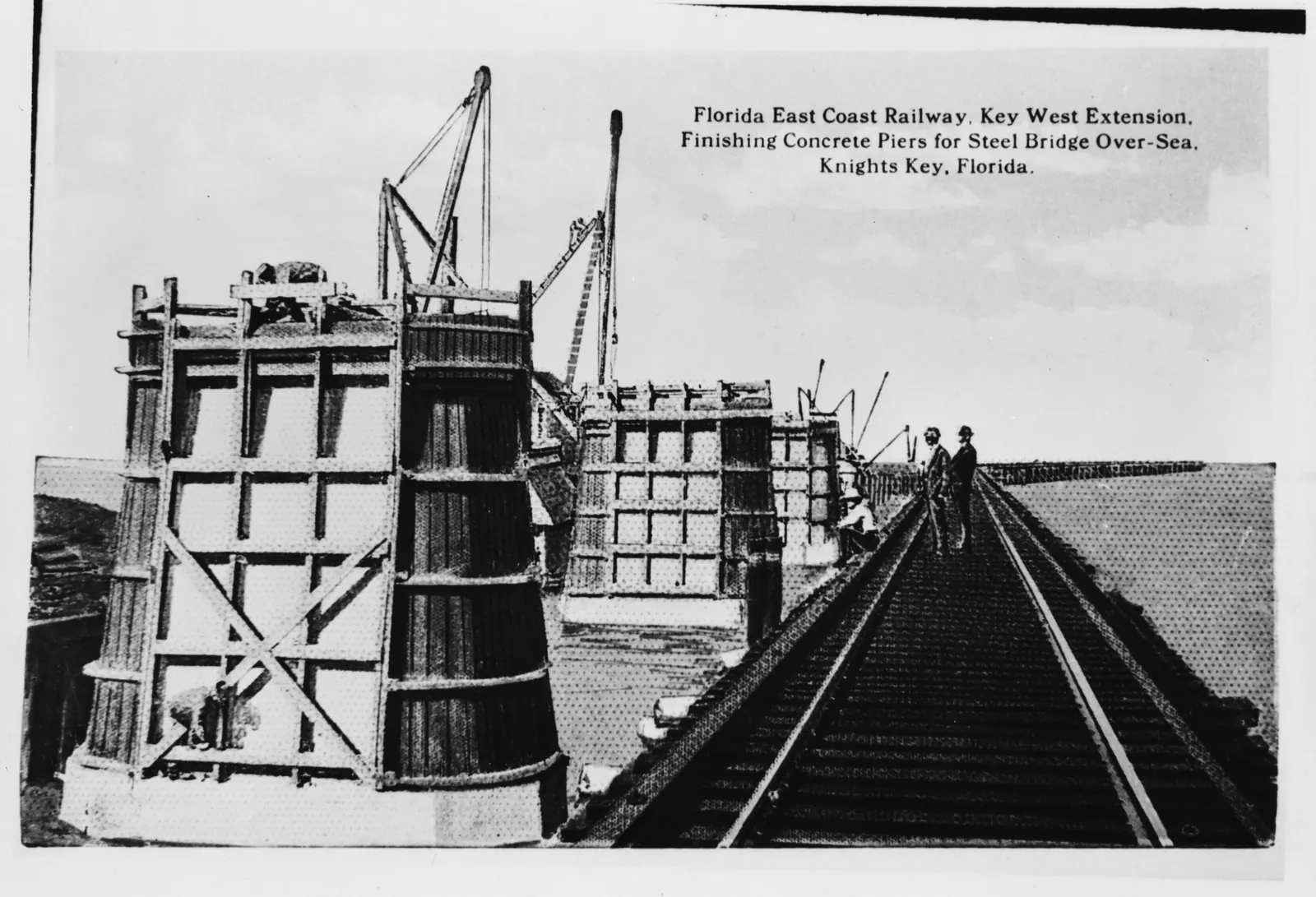
Henry Flagler pushed his Florida East Coast Railway down the island chain over seven years, starting in 1905 and finishing in 1912. The state marker says the Overseas Railroad needed 23 bridges, and it calls the seven-mile crossing below Marathon the longest over-water piece of the line. The railroad reached Knight’s Key first. By 1908, scheduled service connected Miami with Knight’s Key, where Marathon is today, and the long crossing to the south was still on the drawing board. The first train from the mainland pulled into Key West on January 22, 1912. Building through hurricane country had a cost: the Key West weather office records two Category 3 storms coming ashore at Marathon during construction, in October 1906 and October 1909.
- The state historical marker on Knights Key says Henry Flagler extended his Florida East Coast Railway to Key West between 1905 and 1912. The project, called the Overseas Railroad, needed 23 bridges. Florida Department of State historical marker: Old Seven Mile Bridge
- The same marker calls the Old Seven Mile Bridge the longest over-water section of the Overseas Railroad. It used a mix of span types and crossed over Pigeon Key. Florida Department of State historical marker: Old Seven Mile Bridge
- The same timeline says that in 1908 the first regularly scheduled train ran from Miami to Knight's Key, at today's Marathon, while a bridge across the seven-mile stretch below Marathon was still being planned. Florida Keys and Key West: Florida Keys Timeline
- The Florida Keys timeline from the county tourism council marks January 22, 1912 as the day the first train on the Overseas Railroad ran from mainland Florida to Key West. Florida Keys and Key West: Florida Keys Timeline
- The Florida Keys tourism council says the Old Seven Mile Bridge was built as part of Henry Morrison Flagler's Florida Keys Over-Sea Railroad and completed in 1912. Florida Keys and Key West (Monroe County Tourist Development Council): Seven Mile Bridge
- NWS Key West lists two early Category 3 hurricanes that made landfall at Marathon: October 18, 1906 and October 11, 1909, while the railroad was being built. NWS Key West: Strongest Florida Keys Tropical Cyclones
How the bridge was put together
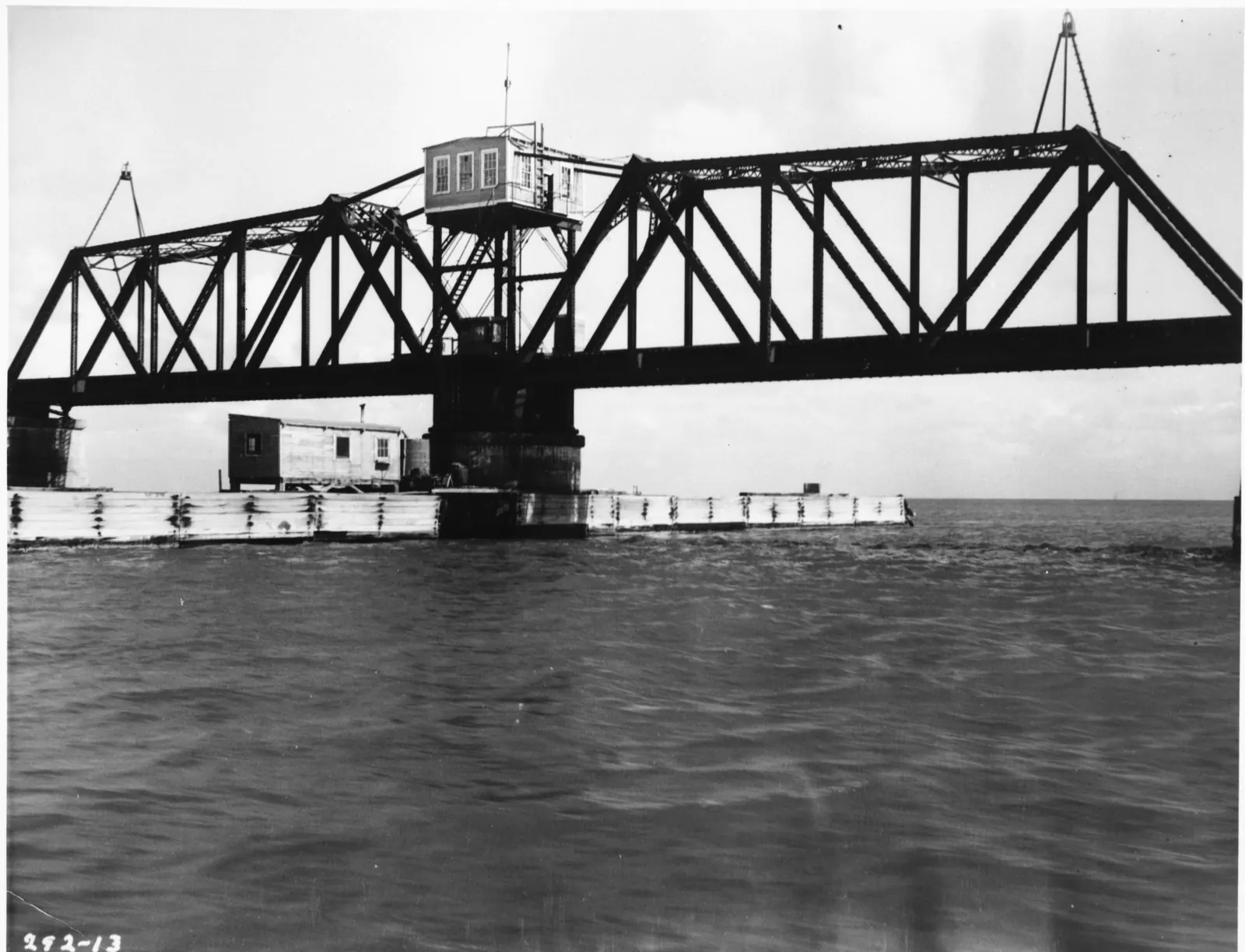
In the tourism council’s description, the bridge was built in four sections, each a run of steel girders resting on concrete piers. Some of those piers reach down to bedrock 28 feet under the surface of the water. To let boats pass between the Gulf and the Atlantic, the line had a swinging span. A photo caption in Pigeon Key’s museum pages places that swing bridge at Moser Channel, about a mile past the island. It is gone now, which is one reason the open walk stops at Pigeon Key.
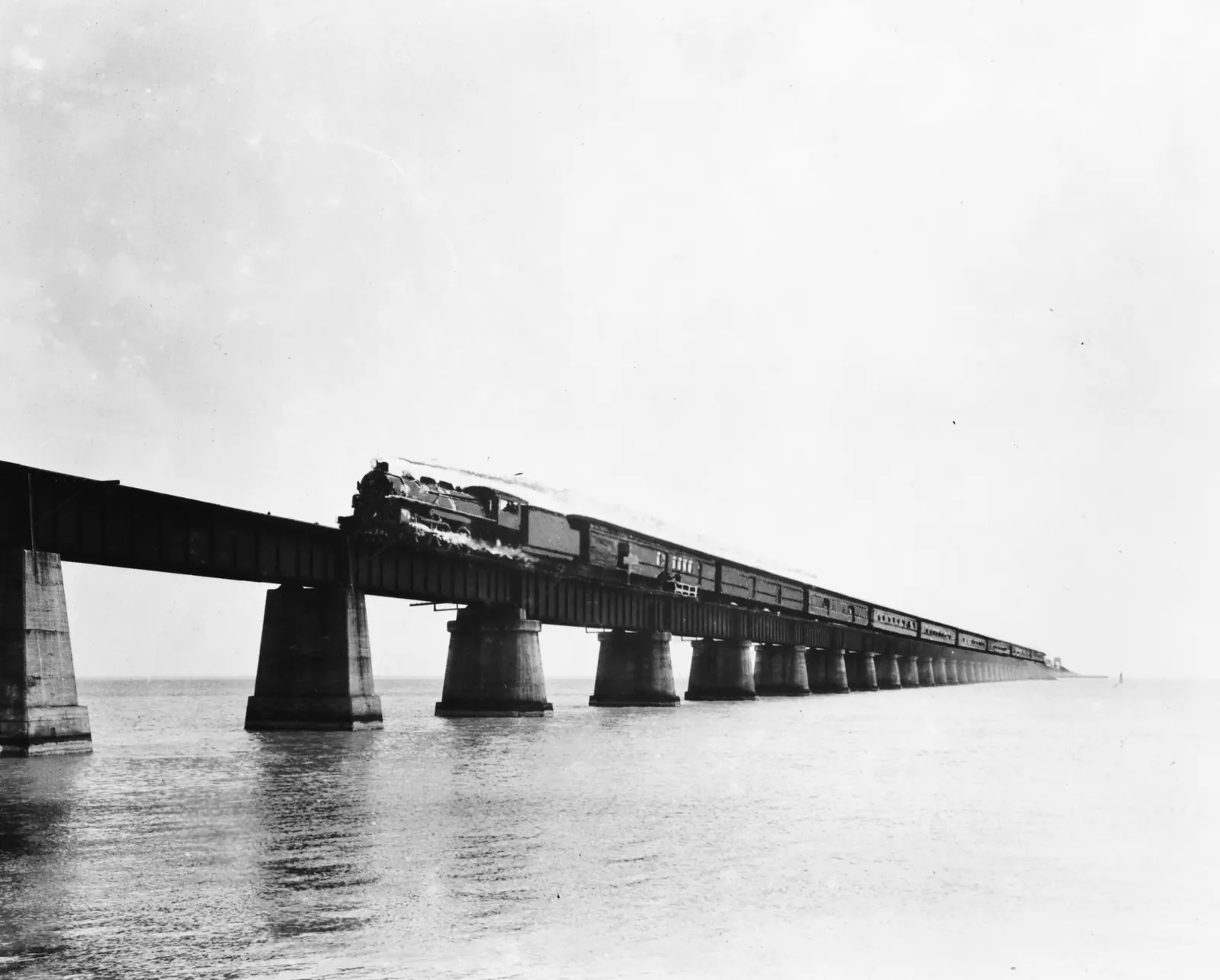
- The tourism council describes the old bridge as four sections of steel-girder spans set on concrete piers. Florida Keys and Key West (Monroe County Tourist Development Council): Seven Mile Bridge
- The old bridge's piers are anchored to bedrock as deep as 28 feet below the waterline, according to the tourism council. Florida Keys and Key West (Monroe County Tourist Development Council): Seven Mile Bridge
- The old bridge had a swinging span that opened so boats could pass between the Gulf and the Atlantic. Florida Keys and Key West (Monroe County Tourist Development Council): Seven Mile Bridge
- A photo caption in the Pigeon Key museum pages places the swing bridge at Moser Channel, about one mile from Pigeon Key. Pigeon Key: Florida Keys History Museum
Pigeon Key, the camp in the middle of the water
Pigeon Key sat right under the line, which made it useful. The marker says the railway used the island as a staging area during construction and later as a permanent camp. Pigeon Key dates its own start to 1908, and the tourism council says up to 400 workers lived there between 1908 and 1912. Once trains were running, the crew that remained looked after the bridge and its tenders. In 1915, during World War I, the Moser Channel span gained a searchlight. A school opened on the island in 1923, which drew more married workers and their families.
- The marker says Pigeon Key served as a Florida East Coast Railway staging area while the bridge was built, and later as a permanent camp. Florida Department of State historical marker: Old Seven Mile Bridge
- Pigeon Key says the island began in 1908 as a railroad construction camp for the seven-mile bridge, and its historic buildings date from that era. Pigeon Key: History
- Up to 400 workers lived on Pigeon Key from 1908 to 1912 while the railroad bridge was built, according to the tourism council. Florida Keys and Key West (Monroe County Tourist Development Council): Seven Mile Bridge
- After the railroad was finished in 1912, Pigeon Key became a maintenance camp for the bridge tenders, according to Pigeon Key's history page. Pigeon Key: History
- Pigeon Key's history page says a searchlight was installed on the Moser Channel Bridge in 1915, during World War I. Pigeon Key: History
- A school opened on Pigeon Key in 1923, which brought more married workers and their families to the island. Pigeon Key: History
Labor Day, 1935
The storm that ended the railroad was a Category 5 hurricane when it reached the middle Keys. Barometers at Long Key read 26.35 inches, a record low for any hurricane to strike the United States. The National Hurricane Center counts 408 deaths in the Keys from its wind and tides. Most of the dead were veterans of the First World War who had been sent to the Keys for work. NWS Key West puts the landfall at Craig Key with sustained winds of 185 mph. With much of the Upper Keys line destroyed, Pigeon Key became the base at the south end of the rescue effort, where relief work and evacuations were run. The railroad never ran again; the marker says it was abandoned after the storm.
- The National Hurricane Center says the 1935 Labor Day Hurricane was a Category 5 storm when it reached the middle Florida Keys on September 2, 1935. NOAA National Hurricane Center: Hurricanes in History
- A pressure of 26.35 inches was measured at Long Key during the 1935 storm, making it the most intense hurricane on record to hit the United States, according to the National Hurricane Center. NOAA National Hurricane Center: Hurricanes in History
- The National Hurricane Center says winds and tides from the 1935 storm caused 408 deaths in the Florida Keys, mostly World War I veterans working in the area. NOAA National Hurricane Center: Hurricanes in History
- The National Weather Service office in Key West lists the Labor Day Hurricane's Keys landfall at Craig Key with 185 mph sustained winds, dated September 3, 1935. NWS Key West: Strongest Florida Keys Tropical Cyclones
- After the 1935 hurricane destroyed large parts of the railroad in the Upper Keys, Pigeon Key served as the southern base for rescue, relief and evacuation work. Pigeon Key: History
- The tourism council's reopening release says the railroad stopped running in 1935. Florida Keys News Bureau: Historic Old Seven Mile Bridge Reopens in the Florida Keys
- The state marker says the 1935 Labor Day Hurricane severely damaged the railroad, which was then abandoned. Florida Department of State historical marker: Old Seven Mile Bridge
From rails to a road, 1936 to 1938
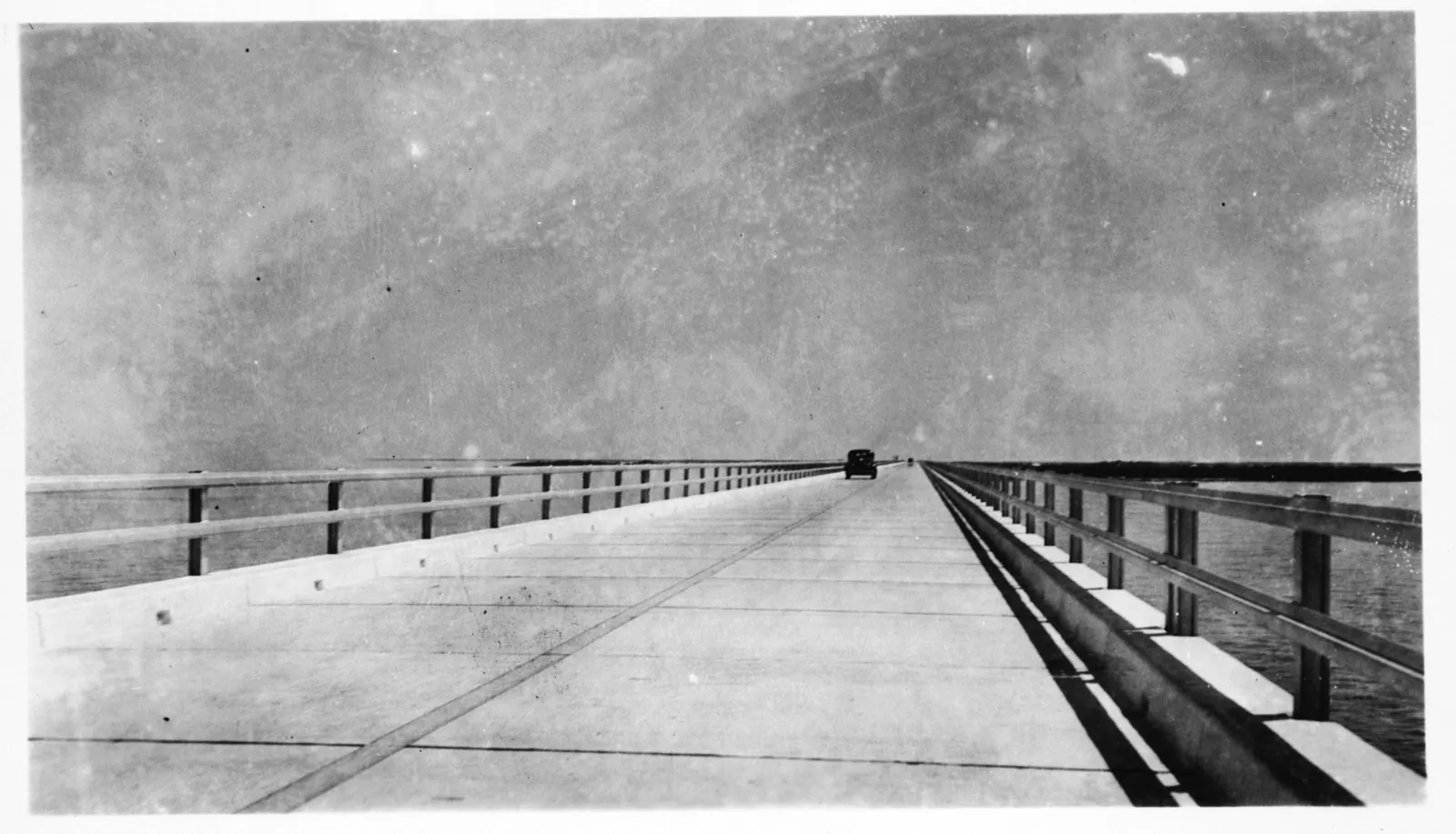
The state took over the dead railroad’s route in 1936. Florida State Parks puts the price at $640,000, paid by the state together with Monroe County. Crews then spent two years turning the railroad bridges into highway bridges. On the Seven Mile crossing they set fresh steel I-beams to carry the road deck, and the old rails went back up as guardrails. The Overseas Highway opened in 1938, and drivers no longer needed ferries to get between Miami and Key West.
- In 1936 the State of Florida bought the abandoned railway right-of-way and converted the bridges to carry cars between 1936 and 1938, according to the state marker. Florida Department of State historical marker: Old Seven Mile Bridge
- Florida State Parks says the railroad was sold to the State of Florida and Monroe County for $640,000 before the Overseas Highway opened in 1938. Florida State Parks: History of Bahia Honda Bridge
- To convert the bridge for cars, engineers laid new steel I-beams for the roadway, and the old rails were reused as guardrails, the marker says. Florida Department of State historical marker: Old Seven Mile Bridge
- The state marker says the Overseas Highway opened on March 29, 1938, ending the need for ferries between Miami and Key West. Florida Department of State historical marker: Old Seven Mile Bridge
- The county tourism timeline gives July 2, 1938 as the date the Overseas Highway officially opened as the highway route through the Keys. Florida Keys and Key West: Florida Keys Timeline
The new road was a toll road at first. Pigeon Key served as home of the Florida Road and Toll Bridge District from 1938 to 1954. In 1943 the Coast Guard built barracks there for the men who patrolled the road in wartime. When the tolls ended in 1954, the district was dissolved and its Pigeon Key land passed to Monroe County.
- Pigeon Key's history page says the Overseas Highway opened as a toll road in 1938 and stayed a toll road until 1954. Pigeon Key: History
- From 1938 to 1954 Pigeon Key was home to the Florida Road and Toll Bridge District, according to the county tourism timeline. Florida Keys and Key West: Florida Keys Timeline
- In 1943 the Coast Guard put barracks on Pigeon Key for crews patrolling the highway during World War II. Pigeon Key: History
- When tolls ended in 1954 the Toll District was dissolved and the land on Pigeon Key was transferred to Monroe County, Pigeon Key says. Pigeon Key: History
Forty-four years of car traffic
Converted, the old bridge served drivers for 44 years. Storms kept testing it. Hurricane Donna, which NWS Key West lists as a Category 4 at Conch Key on September 10, 1960, left two of the island’s buildings so wrecked that they were burned rather than repaired.
- After its 1938 conversion the old bridge carried car traffic for 44 years, until the new bridge opened in 1982. Florida Keys and Key West (Monroe County Tourist Development Council): Seven Mile Bridge
- The National Weather Service in Key West lists Hurricane Donna's landfall at Conch Key on September 10, 1960, as a Category 4 storm with 145 mph winds. NWS Key West: Strongest Florida Keys Tropical Cyclones
- Hurricane Donna in 1960 damaged two Pigeon Key buildings so badly that they had to be burned down. Pigeon Key: History
1982: a new bridge to the south
A new concrete bridge, built just to the south, took over the traffic in 1982. Pigeon Key’s history page notes that it was dedicated that year and skipped the island entirely. With it, a program of 37 new bridges was complete, all built to replace the railroad-era crossings. The old steel swing span was removed at the same time. A footrace across the new bridge began that year as a dedication run, and the 7 Mile Bridge Run still uses the modern bridge, not the old one.
- The state marker says a new bridge built to the south replaced the old one in 1982. Florida Department of State historical marker: Old Seven Mile Bridge
- The modern Seven Mile Bridge opened to traffic in 1982, according to the tourism council. Florida Keys and Key West (Monroe County Tourist Development Council): Seven Mile Bridge
- Pigeon Key's history page says the new Seven Mile Bridge was dedicated in 1982 and bypassed Pigeon Key entirely. Pigeon Key: History
- Finishing the new Seven Mile Bridge completed a program that built 37 new Keys bridges to replace early 1900s railroad bridges. Florida Keys and Key West (Monroe County Tourist Development Council): Seven Mile Bridge
- The tourism council's reopening release says the old steel swing span was removed when the new Seven Mile Bridge was completed in 1982. Florida Keys News Bureau: Historic Old Seven Mile Bridge Reopens in the Florida Keys
- The race began in 1982 as a dedication run for the opening of the new Seven Mile Bridge. Florida Keys and Key West: Seven Mile Bridge Closed Saturday April 11
On the National Register
Federal recognition came in 1979, when the bridge joined the National Register as part of a group the Park Service calls Overseas Highway and Railway Bridges, reference 79000684. The same group takes in the old crossings from Long Key to Conch Key and from Bahia Honda to Spanish Key. It cites commerce, engineering and transportation, and it credits two builders: the railway itself and the commission that ran the toll highway. Pigeon Key has its own listing, the Pigeon Key Historic District, recorded in 1990. Pigeon Key’s site claims a higher federal title for the island, but the record we opened is a Register listing, so that is the term we use.
- The Old Seven Mile Bridge was listed on the National Register of Historic Places in 1979, according to the state marker. Florida Department of State historical marker: Old Seven Mile Bridge
- The National Park Service record lists the bridge under the name "Overseas Highway and Railway Bridges," reference number 79000684, with a date of August 13, 1979. National Park Service NPGallery: Overseas Highway and Railway Bridges
- That National Register listing covers the old bridges on U.S. 1 between Long Key and Conch Key, between Knight Key and Little Duck Key, and between Bahia Honda and Spanish Key, as the record words it. National Park Service NPGallery: Overseas Highway and Railway Bridges
- The National Park Service lists the bridges as significant for commerce, engineering and transportation, with significant years of 1905, 1912 and 1936. National Park Service NPGallery: Overseas Highway and Railway Bridges
- The National Register record names the Florida East Coast Railway and the Overseas Highway and Toll Bridge Commission as the builders. National Park Service NPGallery: Overseas Highway and Railway Bridges
- Pigeon Key is on the National Register as the Pigeon Key Historic District, reference number 90000443, with a record date of March 16, 1990. National Park Service NPGallery: Pigeon Key Historic District
- The district is listed for transportation and architecture, covering 1900 to 1949, with 1912, 1939 and 1940 named as significant years. National Park Service NPGallery: Pigeon Key Historic District
- Pigeon Key's site says the island was designated a National Historic Landmark in 1990. The National Park Service record we opened shows a National Register listing (Pigeon Key Historic District, 90000443), not a Landmark designation. Say "listed on the National Register of Historic Places." National Park Service NPGallery: Pigeon Key Historic District
To protect what was left of the Flagler era, the island’s caretakers formed a tax-exempt nonprofit in 1992. The other bridges in that 1979 listing get their own page: the old bridges of the Keys.
- Pigeon Key became a 501(c)(3) nonprofit in 1992 to protect its Flagler-era history. Pigeon Key: History
Restoring the span, 2017 to 2022
By the 2010s the old bridge was worn out. In FDOT’s words, a hundred-plus years of salt had eaten into the steel and the concrete, and without work the bridge would have had to close permanently. It was still popular: Pigeon Key’s director said close to 250,000 people used it in the final year before the closure. The restoration covered structural steel, bridge joints, and new decking and handrails. It sits inside a three-decade, $77 million deal that the state transportation department, Monroe County and Marathon’s city government all ratified. We have not seen a primary document showing what share each partner pays.
- FDOT says more than a century of salt water had badly worn the bridge's steel and concrete, and it had to act to avoid closing the bridge for good. America's Transportation Awards: FDOT Old Seven Mile Bridge Restoration and Rehabilitation Project
- Pigeon Key's executive director told the tourism council that nearly a quarter-million people used the old bridge in the year before it closed for restoration. Florida Keys News Bureau: Historic Old Seven Mile Bridge Reopens in the Florida Keys
- Restoration work on the old span began in 2017, according to the tourism council's news bureau. Florida Keys News Bureau: Historic Old Seven Mile Bridge Reopens in the Florida Keys
- FDOT's project summary lists structural steel repairs, bridge joint repairs, and new decking and handrails for walkers and cyclists. America's Transportation Awards: FDOT Old Seven Mile Bridge Restoration and Rehabilitation Project
- The restoration is part of a 30-year agreement with a $77 million budget, ratified by Monroe County, the City of Marathon and the Florida Department of Transportation. Florida Keys News Bureau: Historic Old Seven Mile Bridge Reopens in the Florida Keys
- The restoration agreement is a 30-year, $77 million deal among FDOT, Monroe County and the City of Marathon. The share each partner pays, and any Tourist Development Council or Pigeon Key Foundation contribution, are not confirmed from a primary source as of Oct 24, 2026. Florida Keys News Bureau: Historic Old Seven Mile Bridge Reopens in the Florida Keys
Walkers and cyclists got the span back on a Wednesday, January 12, 2022, which the tourism council marked as 110 years after its first opening. In 2021 the state placed the historical marker on Knights Key, on the north side of the highway, so it is the first thing many walkers read. Our walking and biking page covers the trip out today.
- The restored span reopened for walking and biking on Wednesday, January 12, 2022, 110 years after the bridge first opened. Florida Keys News Bureau: Historic Old Seven Mile Bridge Reopens in the Florida Keys
- The state marker says the Florida Department of Transportation rehabilitated about 2 miles of the original bridge in 2021. Florida Department of State historical marker: Old Seven Mile Bridge
- The Old Seven Mile Bridge historical marker stands at the northwestern end of Knights Key, north of the Overseas Highway, in Marathon. It was placed in 2021. Florida Department of State historical marker: Old Seven Mile Bridge
The modern bridge, now in its own repair years
The 1982 bridge is aging too. FDOT began work on it in March 2026, covering mile markers 40 through 47, and expects to finish in summer 2029. The $17.7 million job repairs, strengthens and restripes the bridge, with lane closures only at night, Monday to Thursday. FDOT has also put on hold its study of an eventual replacement, and no restart date is set. Driving notes are on our getting here page.
- FDOT began a rehabilitation of the modern Seven Mile Bridge (U.S. 1, mile marker 40 to 47) on March 2, 2026, with completion estimated for summer 2029. FDOT District Six: Seven Mile Bridge over Moser Channel, project 446231-1-52-01
- FDOT lists the rehabilitation at $17.7 million, with Freyssinet, Inc. as contractor. The work repairs, strengthens and restripes the bridge. FDOT District Six: Seven Mile Bridge over Moser Channel, project 446231-1-52-01
- During the rehabilitation, FDOT allows U.S. 1 lane closures on the Seven Mile Bridge only from 8 p.m. to 6 a.m., Monday through Thursday, on non-event days. FDOT District Six: Seven Mile Bridge over Moser Channel, project 446231-1-52-01
- FDOT's study of a future replacement for the modern Seven Mile Bridge is paused, and FDOT says no date has been set to resume it. FDOT District Six: Seven Mile Bridge PD&E Study
Historic places to visit
Florida Historical Marker: Old Seven Mile Bridge
historical marker
Northwestern end of Knights Key, north of the Overseas Highway, Marathon, FL 33050
A 2021 state marker at the Knights Key end telling the story of the 23 Overseas Railroad bridges, the camp on Pigeon Key, the 1935 hurricane, the state's 1936 purchase and the 1936 to 1938 conversion to a highway, which opened in March 1938. It notes the 1979 National Register listing and FDOT's 2021 rehabilitation of about 2 miles of the old bridge.
Source: Florida Department of State: Florida Historical Marker Details, 'Old Seven Mile Bridge', checked 2026-10-24
Overseas Highway and Railway Bridges (National Register district)
National Register historic district
Bridges on US 1 between Long and Conch Keys, Knights and Little Duck Keys, and Bahia Honda and Spanish Keys, Monroe County, FL
The old Flagler bridges, including the Old Seven Mile Bridge, were listed together on the National Register of Historic Places on August 13, 1979, for their importance to commerce, engineering and transportation.
Source: National Park Service NPGallery: NRIS 79000684, Overseas Highway and Railway Bridges, checked 2026-10-24
Pigeon Key railroad camp
historic site
Pigeon Key, Marathon, FL 33050
Pigeon Key began in 1908 as the construction camp for the bridge, with more than 400 workers, a post office, commissary and one-room school. After 1912 it became a bridge maintenance camp, then a base for the toll road and highway, and later a marine research station. The Foundation says it was designated a National Historic Landmark in 1990.
9:00 am to 4:00 pm, every day except major holidays
Source: Pigeon Key Foundation: Pigeon Key History; Monroe County: Pigeon Key, checked 2026-10-24
Knights Key
historic island
Knights Key, Marathon, FL 33050
The island at the Marathon end of the bridge. The City of Marathon calls the old span the original Knights Key Bridge, built in the early 1900s as part of Henry Flagler's Key West Extension.
Source: City of Marathon: Old Seven-Mile Bridge, checked 2026-10-24
Bahia Honda Rail Bridge
historic bridge
Bahia Honda State Park, 36850 Overseas Highway, Big Pine Key, FL 33043
Because the water here is so deep, the railroad used steel trusses instead of the concrete arches seen elsewhere. After the 1935 hurricane the state added a concrete road deck on top of the trusses, and the Overseas Highway opened across it in 1938.
8:00 am to sundown, 365 days a year (state park)
Source: Florida State Parks: History of Bahia Honda Bridge, checked 2026-10-24
Florida Historical Marker: Tree Colony, Bahia Honda Key
historical marker
Old Bahia Honda Bridge, near the dock, Bahia Honda State Park, Big Pine Key, FL 33043
A 1968 state marker by the old bridge about the rare West Indian plants that birds, wind and waves carried to Bahia Honda Key, some found growing wild nowhere else, such as the West Indies satinwood.
8:00 am to sundown, 365 days a year (state park)
Source: Florida Department of State: Florida Historical Marker Details, 'Tree Colony, Bahia Honda Key', checked 2026-10-24
Long Key Bridge (Long Key Viaduct)
historic bridge
Florida Keys Overseas Heritage Trail between Long Key and Conch Key, Monroe County, FL
The Flagler bridge between Long Key and Conch Key, part of the 1979 National Register listing of the Overseas Highway and Railway Bridges. When the railroad reached Long Key it was the longest bridge on the line at that point.
Source: National Park Service NPGallery: NRIS 79000684; Florida State Parks: Long Key State Park History, checked 2026-10-24
Long Key Fishing Camp site (Long Key State Park)
historic site in a state park
67400 Overseas Highway, Long Key, FL 33001
Flagler's railroad built a fishing resort on Long Key that drew Zane Grey and U.S. presidents; a small train carried guests from the bayside docks to the hotel from 1907 to 1935, and its wheels sit in front of the ranger station. The 1935 Labor Day Hurricane destroyed the camp.
8:00 am to sunset, 365 days a year
Source: Florida State Parks: History, Long Key State Park, checked 2026-10-24
Seven Mile Bridge history FAQ
What is the Old Seven Mile Bridge?
It is the original Flagler railroad bridge between Marathon and the Lower Keys, completed in 1912 and later used as a car road. Today a restored 2.2-mile part is a walking and biking path out to Pigeon Key.
Source: Florida Keys and Key West (Monroe County Tourist Development Council): Seven Mile Bridge
What is Pigeon Key?
A 5-acre island under the old bridge that began in 1908 as a railroad work camp. Today a nonprofit runs it as a museum, marine science center and visitor attraction.
Source: Pigeon Key: History
What is in the Pigeon Key museum?
Early 1900s photographs, original tools, handwritten letters and portraits, with exhibits on building the railway, workers' daily life and the island's ecosystem.
Which building is the museum in?
The original home of the Assistant Bridge Tender. Pigeon Key calls it the Florida Keys History Museum.
Source: Pigeon Key: History
What buildings can I see on Pigeon Key?
The tourism council says visitors can tour the former section gang quarters and the paint foreman's dorm and visit the museum.
Source: Florida Keys and Key West (Monroe County Tourist Development Council): Seven Mile Bridge
Who runs Pigeon Key?
A 501(c)(3) nonprofit formed in 1992. Its site calls it Pigeon Key and Marine Science Center; the tourism council calls it the Pigeon Key Foundation.
Source: Pigeon Key: Mission
Is Pigeon Key on the National Register of Historic Places?
Yes. The National Park Service lists the Pigeon Key Historic District, reference 90000443, with a record date of March 16, 1990.
Source: National Park Service NPGallery: Pigeon Key Historic District
How many people lived on Pigeon Key when the bridge was built?
Up to 400 workers lived there from 1908 to 1912, according to the tourism council.
Source: Florida Keys and Key West (Monroe County Tourist Development Council): Seven Mile Bridge
Who built the Old Seven Mile Bridge?
Henry Flagler's Florida East Coast Railway, as part of the Overseas Railroad to Key West built between 1905 and 1912.
Source: Florida Department of State historical marker: Old Seven Mile Bridge
When was the Old Seven Mile Bridge finished?
In 1912. The county tourism timeline marks January 22, 1912 as the day the first train reached Key West.
How many bridges did the Overseas Railroad need?
The state marker says the Overseas Railroad required 23 bridges, and the Old Seven Mile Bridge was the longest over-water section.
Source: Florida Department of State historical marker: Old Seven Mile Bridge
How is the old bridge built?
It is four sections of steel-girder spans on concrete piers, anchored to bedrock as deep as 28 feet below the waterline.
Source: Florida Keys and Key West (Monroe County Tourist Development Council): Seven Mile Bridge
Did the old bridge have a drawbridge?
Yes. It had a swing span at Moser Channel that opened for boats. It was removed when the new bridge was completed in 1982.
Source: Florida Keys News Bureau: Historic Old Seven Mile Bridge Reopens in the Florida Keys
What happened to the railroad?
The 1935 Labor Day Hurricane badly damaged it and the railroad was abandoned. The state bought the right-of-way in 1936 and rebuilt the bridges for cars.
Source: Florida Department of State historical marker: Old Seven Mile Bridge
How strong was the 1935 Labor Day Hurricane?
It was a Category 5 storm in the middle Keys. A pressure of 26.35 inches at Long Key makes it the most intense hurricane on record to hit the United States.
Source: NOAA National Hurricane Center: Hurricanes in History
How many people died in the 1935 hurricane?
The National Hurricane Center says 408 people died in the Keys, mostly World War I veterans working in the area.
Source: NOAA National Hurricane Center: Hurricanes in History
What role did Pigeon Key play after the 1935 hurricane?
Pigeon Key served as the southern base for rescue, relief and evacuation work after the storm.
Source: Pigeon Key: History
When did the old bridge become a highway?
The bridges were converted for cars from 1936 to 1938. The Overseas Highway opened in 1938, with March 29 on the state marker.
Source: Florida Department of State historical marker: Old Seven Mile Bridge
Are the railings really old train rails?
Yes. The state marker says the old rails were reused as guardrails when the bridge was rebuilt for cars.
Source: Florida Department of State historical marker: Old Seven Mile Bridge
Was the Overseas Highway a toll road?
Yes. Pigeon Key says it opened as a toll road in 1938 and tolls ended in 1954, when the Pigeon Key land passed to Monroe County.
Source: Pigeon Key: History
How long did cars use the old bridge?
For 44 years, from 1938 until the new Seven Mile Bridge opened in 1982.
Source: Florida Keys and Key West (Monroe County Tourist Development Council): Seven Mile Bridge
Is the Old Seven Mile Bridge on the National Register?
Yes. It was listed in 1979 as part of the "Overseas Highway and Railway Bridges," National Register reference 79000684.
Source: National Park Service NPGallery: Overseas Highway and Railway Bridges
Is there a historical marker at the bridge?
Yes. A state marker placed in 2021 stands at the northwestern end of Knights Key, north of the Overseas Highway.
Source: Florida Department of State historical marker: Old Seven Mile Bridge
Why was the old bridge closed for years?
FDOT says a century of salt water had badly worn its steel and concrete. It had to repair the bridge to avoid closing it for good.
Source: America's Transportation Awards: FDOT Old Seven Mile Bridge Restoration and Rehabilitation Project
How much did the restoration cost?
About $43 to $44 million. The tourism council says $44 million and FDOT's awards entry says $43 million.
Source: Florida Keys News Bureau: Historic Old Seven Mile Bridge Reopens in the Florida Keys
Who paid to restore the old bridge?
Monroe County, the City of Marathon and FDOT ratified a 30-year agreement with a $77 million budget to restore and maintain the span.
Source: Florida Keys News Bureau: Historic Old Seven Mile Bridge Reopens in the Florida Keys
What work was done in the restoration?
FDOT lists structural steel repairs, bridge joint repairs, and new decking and handrails for walkers and cyclists.
Source: America's Transportation Awards: FDOT Old Seven Mile Bridge Restoration and Rehabilitation Project
When did the old bridge reopen?
On Wednesday, January 12, 2022, 110 years after the bridge first opened.
Source: Florida Keys News Bureau: Historic Old Seven Mile Bridge Reopens in the Florida Keys
How long is the new Seven Mile Bridge?
About 6.79 miles, or nearly 36,000 feet, so a little short of seven miles. It has 440 precast concrete spans.
Source: Florida Keys and Key West (Monroe County Tourist Development Council): Seven Mile Bridge
When did the new Seven Mile Bridge open?
In 1982. It bypassed Pigeon Key entirely, and boats pass under its 65-foot high point.
Source: Pigeon Key: History
Why does the old Bahia Honda Bridge look different?
The railroad bridge was too narrow for cars, so engineers built the road on a concrete deck on top of the steel truss.
What was the Long Key Fishing Camp?
A railroad-era camp that drew famous anglers such as Zane Grey. The 1935 hurricane destroyed it and it never reopened.
Which old bridges are on the National Register with the Seven Mile Bridge?
The 1979 listing covers the old bridges between Long Key and Conch Key, Knight Key and Little Duck Key, and Bahia Honda and Spanish Key.
Source: National Park Service NPGallery: Overseas Highway and Railway Bridges
Which hurricanes have hit near the bridge?
NWS Key West lists Category 3 landfalls at Marathon in 1906 and 1909, Donna at Conch Key in 1960 and Irma at Cudjoe Key in 2017.
Source: NWS Key West: Strongest Florida Keys Tropical Cyclones
Is the Overseas Highway an All-American Road?
Yes. The Overseas Highway was named an All-American Road in 2009.
Dates, rules and hours can change. The organisers have the final word: Pigeon Key Foundation (official site)